King Edward VII's operation
On Saturday 14 June 1902, less than two weeks before his coronation, Prince Edward travelled to Aldershot to attend a military review where he started getting a stabbing pain in his abdomen. That night, it got much worse and by 5am, the King's personal physician Sir Francis Laking was summoned. Laking asked Sir Thomas Barlow, Physician-Extraordinary to the King for a second opinion as by now he had a fever and was experiencing extreme tenderness in the right-hand side of his enormous stomach. Edward was transferred to Windsor Castle under heavy sedation, leaving Queen Alexandra to review the parade of 30,000 troops gathered at Aldershot.
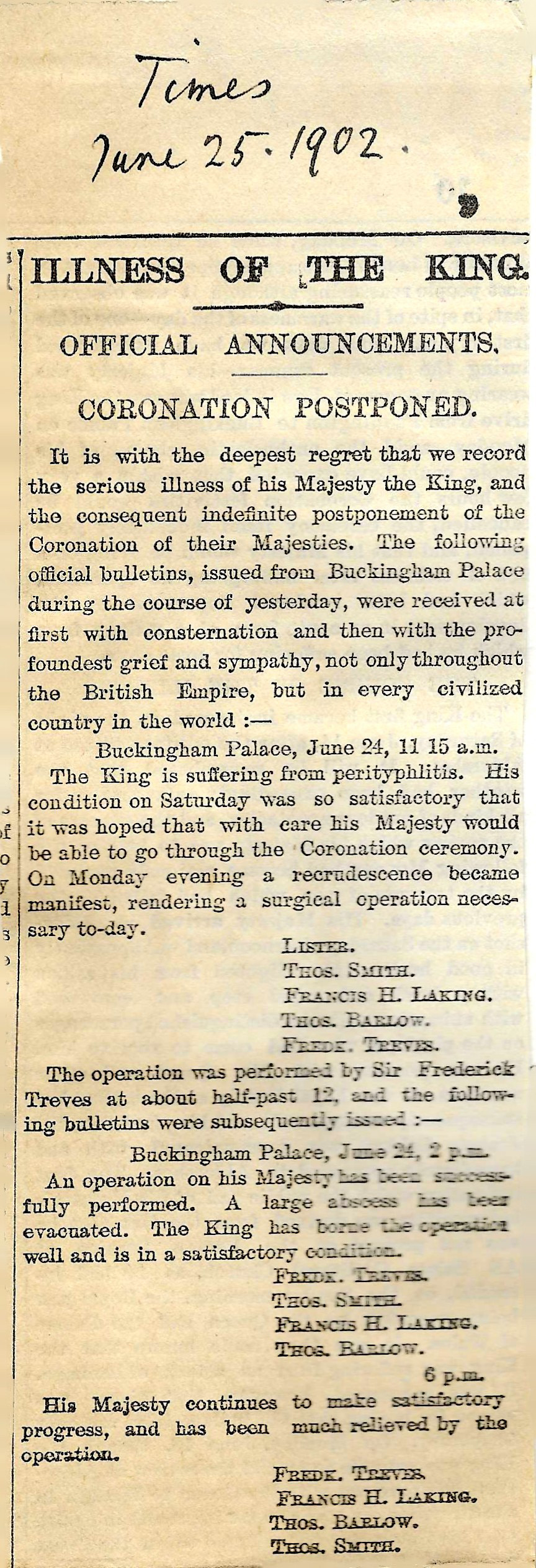
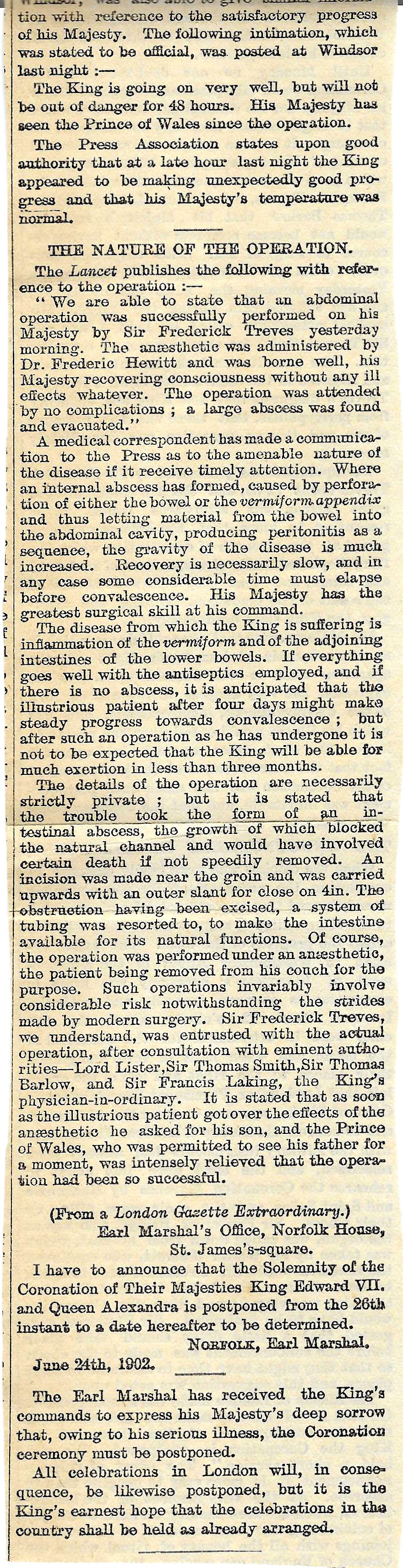
Edward rallied a little over the next few days, so he received a few visitors and went for drives, but a ball planned for the 20th was cancelled. He returned to London on the 23rd and although the journey from Windsor had been bearable, he was on the verge of collapse. Despite a steely determination to go ahead with the Coronation he was forced to accept defeat and an operation was unavoidable. Appendicectomy is actually inaccurate: it was an appendix abscess that the medical team had to drain on 24th June 1902. Luckily for us, Fred’s dedication to his diary has left us with a unique and evocative first-hand account of the societal norms (strict), royal protocol (stiff) and medical practices (fairly lax) in place on the day.
NB This account is the intellectual property of the Hewitt (and blood relative) family and is
NOT TO BE COPIED, EDITED, OR POSTED IN ANY FORM ON ANOTHER WEBSITE
under any circumstances.
Fred's personal account
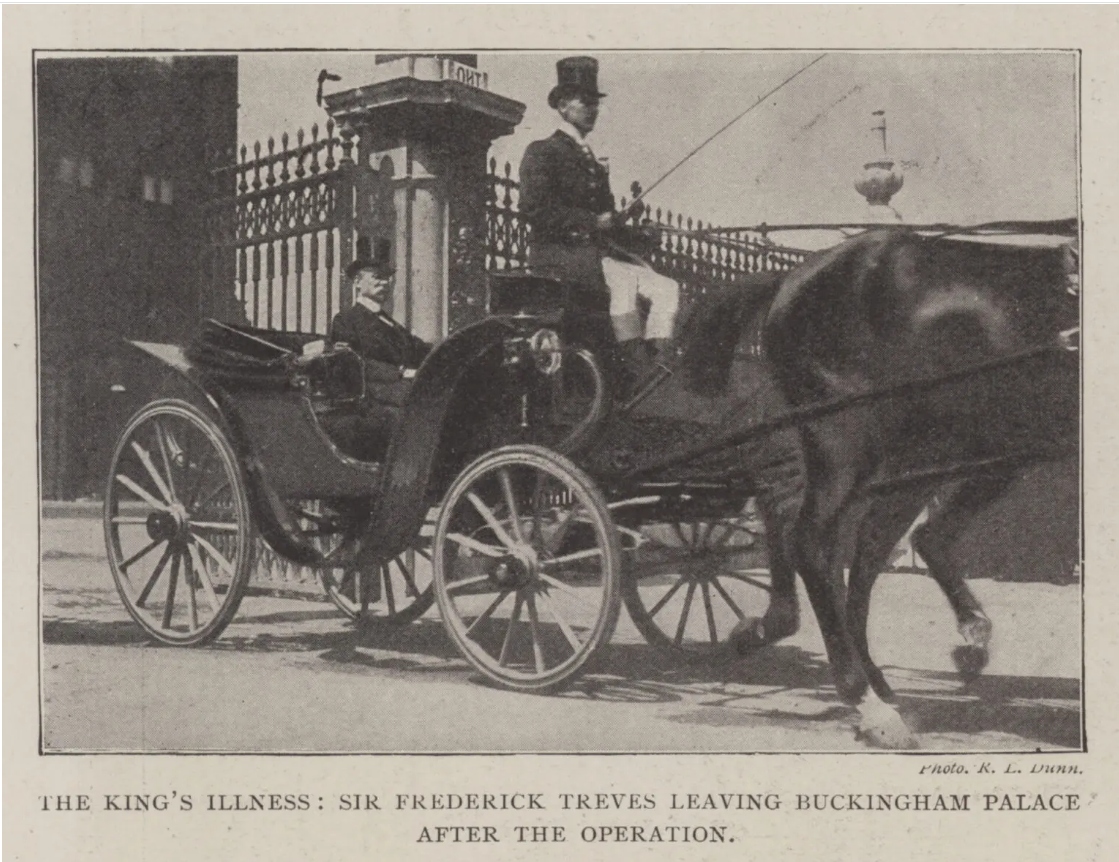
I had been warned the day before that I might be wanted to anaesthetise the King. I was ordered by the great Sir Frederick Treves not to leave the house after 10am, and he called for me around 11.30. He said he was in a great hurry, and I should be required almost at once. Seeing my Victoria outside, he asked if I could get the Brougham round as soon as possible and then pick up his nurse at Wimpole Street and drive her on. Chilton went off to get the Brougham and returned in about 10 minutes.
I said that there was one thing I considered important from my point of view and that was that I should be allowed to examine the King before giving the anaesthetic. Sir Frederick said that he could tell me all about him and rather hinted that any examination would be unnecessary. But I felt determined in my own mind not to give way on this point.
Sir Frederick drove off to his house and I followed in a short time. When I got there the great surgeon was in his shirt sleeves eating a good luncheon with Lady Treves helping him in a thousand and one little ways. I confess, I felt inclined for luncheon as I had had a very early and light breakfast, but a poor anaesthetist is not supposed to sit at a great man’s table, so I held a watching brief. The last glass of claret having disappeared, the great man started off directing me to follow the nurse in about 5 minutes. This I did but I stopped at a pastry cook’s and got some chocolate which I ate as we drove through the unsuspecting throngs in and around the park.
The great event of the year was to come off in a few days. Everything was in a state of ebullition. The weather was glorious, the finishing touches were being put to triumphal arches and stands, flags were flying in every street and square, house decorations were in progress even in the remotest suburbs, the whole world was on the tiptoe of excitement and expectation. Men, women and children jostled against one another in the main thoroughfares not knowing whether to ascribe their ecstasy to the newly concluded peace of Vereeniging (second Boer War) or to the forthcoming coronation of the King. And yet, lying in his palace on a sick bed lay the very man to whom the whole universe was looking for the consummation of happiness.
We were instructed to enter at the Privy Purse entrance to the palace and this we did. No time was lost in getting us into the lift and landing us on the King’s bedroom floor. There I met Sir Thomas Barlow who seemed rather excited. I told him I was anxious to examine his majesty before giving the anaesthetic. This he thought a reasonable request and promised to see if it could be carried out. Everything was in a bustle; everybody was rushing about. This rather tended to make me cool and deliberate – a fortunate result of experience.
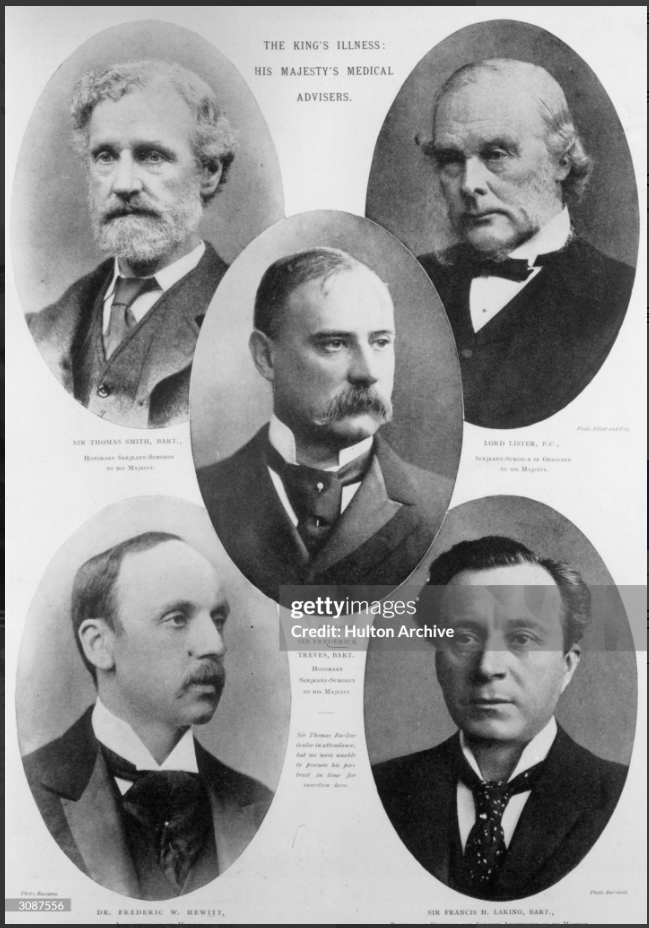
I then entered the King’s dressing room where I found Sir Frederick Treves, Sir Thomas Smith, Sir Thomas Barlow and Sir Francis Laking standing over the operating table that a short time before had been fetched from 51 Welbeck Street. Right glad was I to see the table. I was told, as I entered that it had been agreed that the best course would be to give the King a little anaesthetic as he lay in bed and to move him by means of the sheet, when partly anaesthetised from the bedroom to the operating table. Now I had made up my mind, in the event of any plan of this kind being proposed, to strongly oppose it for I know how likely such a procedure is to lead to difficulties in certain types of subject. I therefore pointed this out. I was very grateful for Sir Frederick for giving way on this point. I then was taken in by Sir Francis Laking to his Majesty’s bedroom through the intervening door. I bowed as I passed the Queen.
Sir Francis Lake said: “This is Dr Hewitt, Your Majesty. You may remember Your Majesty; you gave him an appointment as anaesthetist to Your Majesty.” The King held out his hand and I really don’t know whether I did right in taking it (as I did) in my own, or whether I should not have presented my sleeve for it to rest on. Anyhow I did as I should have done in other circumstances and hope I was right. The King very graciously said: “The name seems familiar to me. Have I met you before?” Foolishly forgetting the fact that I had been presented at a levée I said: “I don’t think I have had the honour, Sir.” I then asked if I might examine His Majesty and he at once assented. “Certainly,” he said, “anything you like.” He was most amenable and kind.
Sir Francis fortunately relieved me of the artificial teeth question by asking: “Your Majesty has no artificial teeth?” And the King answered in the negative, opening his mouth and displaying to my satisfaction (as an anaesthetist) several defective teeth. I then asked him to breathe through his nose and observed that the airway was not very free, although free enough for the avoidance of difficulties. I then placed my stethoscope over the heart area but owing to the well covered chest wall and bed attire, could hear no sounds. I also tested the chest expansion, which was very defective, breathing being chiefly abdominal. I then bowed and returned to the dressing room where everyone was busy with final preparations.
The King’s dressing gown was sent in to him and everyone cleared out of the dressing room except me and Sir Francis. His Majesty walked in. He was rather out of breath but splendidly plucky, there being not the slightest trace of fear or nervousness. He got on to the table and Sir Francis helped. We had to prop the patient up as he could not breathe well lying flat. This made it a little awkward for me but by means of one or two velvet cushions on my chair, I raised myself to nearly the proper level.
Since it was rather inconvenient, I began with CE mixture (2 of E to 3 of C) on a Skinner’s mask, allowing plenty of air, encouraging His Majesty as I went along. I changed to a Rendle’s mask in a couple of minutes. The Queen was standing by and this I now regret, for however one gives an anaesthetic to such a patient, it is impossible to avoid a little rigidity and so called struggling, which to the lay mind may be distressing. I could see that the Queen was, in fact, distressed although there was no need for anxiety from first to last. She appealed to Sir Francis who tried to reassure her. She either caught sight of the King’s strange look or else she thought some of the anaesthetic was getting into His Majesty’s eyes for she exclaimed: “His eye! His eye!” I told her everything was quite right, and Sir Frederick called for a towel which was at once placed over His Majesty’s eyes.
I had determined from the first to choose CE mixture and to give it slowly, and considering the type of patient, we did very well. There was of necessity, some rigidity and slightly suspended breathing, with an inclination for the upper part of the body to rise and come forwards. But I steadily and gradually continued the administration, removing the inhaler as the respiration became suspended (the so-called ‘holding the breath’) and separated the contracted lips with my fingers. At this stage I added about ½ drachm (2.5ml) of ether to the Rendle mask and the stage of rigidity soon subsided.
Almost immediately after the towel had been placed over the King’s eyes, the Queen was persuaded to leave. I very much regret that I did not think of suggesting she should be absent from the beginning of the administration, as the rigid stage and slight change of colour (inevitable in such a patient) must have alarmed her, I fear. We had now got into smooth water and about 13 or 14 minutes after my administration had begun, Sir Frederick Treves made his incision. The abdomen was very large and its wall thick so that it was about 8 or 10 minutes before the pus was reached. A few ounces of very offensive pus were now evacuated to everyone’s relief.
A magnificent flunkey in red was called in to hold the irrigation which he proceeded to do standing on a chair. The flushing out lasted some time. From start to finish (i.e. from beginning the anaesthetic till bandages were put on) the whole affair took 40 minutes. During the operation Sir Thomas Smith held His Majesty’s right arm to be out of Treves’ way, and once or twice confided to me “he would not have my job for all the world”. He also very considerately said if I didn’t want to keep His Majesty deeply under, he would hold him, but I simply did as I was in the habit of doing with other cases.
The operation over, we wheeled His Majesty on the operating table into his bedroom and lifted him back to bed. Soon after, the Queen came in and seemed rather anxious at the King being still deeply asleep. I noticed he was only breathing through his nose, and he was not getting as much air as if free oral breathing were present. This, indeed, helped to account for slightly delayed recovery. I explained to the Queen that by applying a little iced water, breathing would probably begin through the mouth, and this I did with the result I had anticipated: the King immediately woke up. He heard that all was satisfactorily over and expressed himself as very pleased. He did not feel sick nor was he sick till quite late at night.
I waited in the dressing room for some time and then went down with Sir Frederick Treves and Sir Francis Laking, and we did ourselves very well at luncheon. The champagne, as one might have expected, was very good.
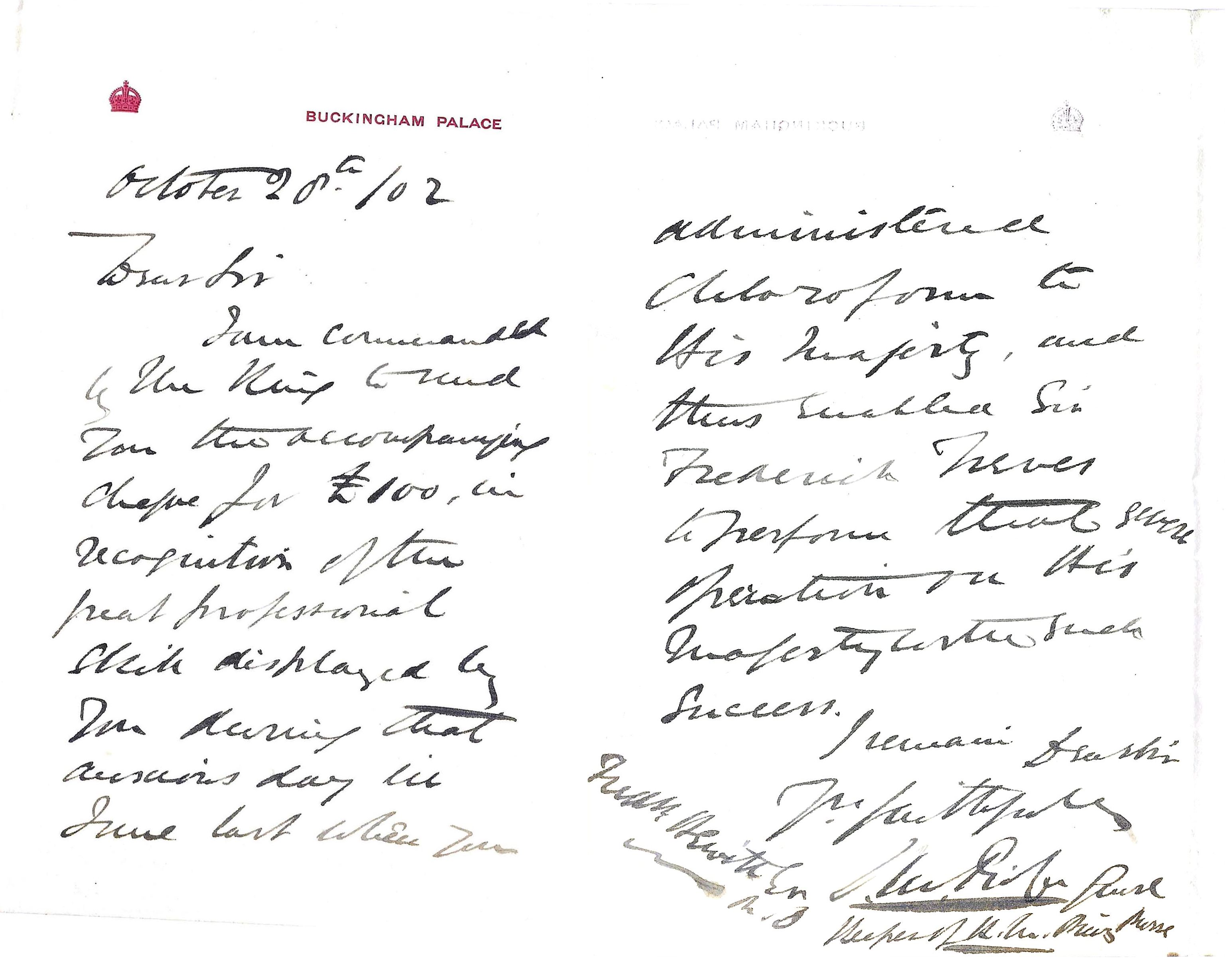
The next day, Edward was sitting up in bed, smoking a cigar and two weeks later, it was announced he was out of danger. Fred received a nice cheque for £100 (approximately £16,000 today) to cover his professional services and was made a Member of the Royal Victorian Order in 1902 as a token of the monarch’s thanks. Years later this honour was compounded when he took a knee for services to medicine in front of Edward’s son, King George V on 20 June 1911, becoming Sir Frederic Hewitt.