Imperial Airways


Imperial Airways Ltd

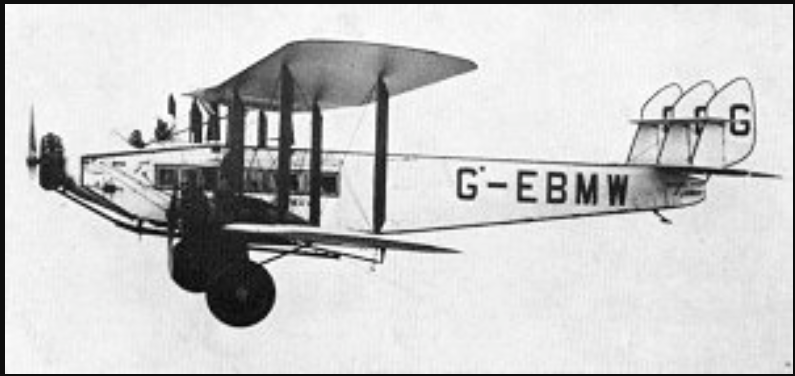
Imperial Airways Limited (IAL) was Britain's pioneering national airline, incorporated on 31 March 1924 with equipment/assets from each of the four merging companies - British Marine Air Navigation Company Ltd, the Daimler Airway, Handley Page Transport Ltd and the Instone Air Line Ltd. Sir Eric Geddes (father of Wyn’s great friend Magnus) was appointed the chairman of the board with one director from each of the merged companies. IAL operated from 1924 to 1939 before merging to form BOAC (now part of British Airways) with land operations based at Croydon Airport.
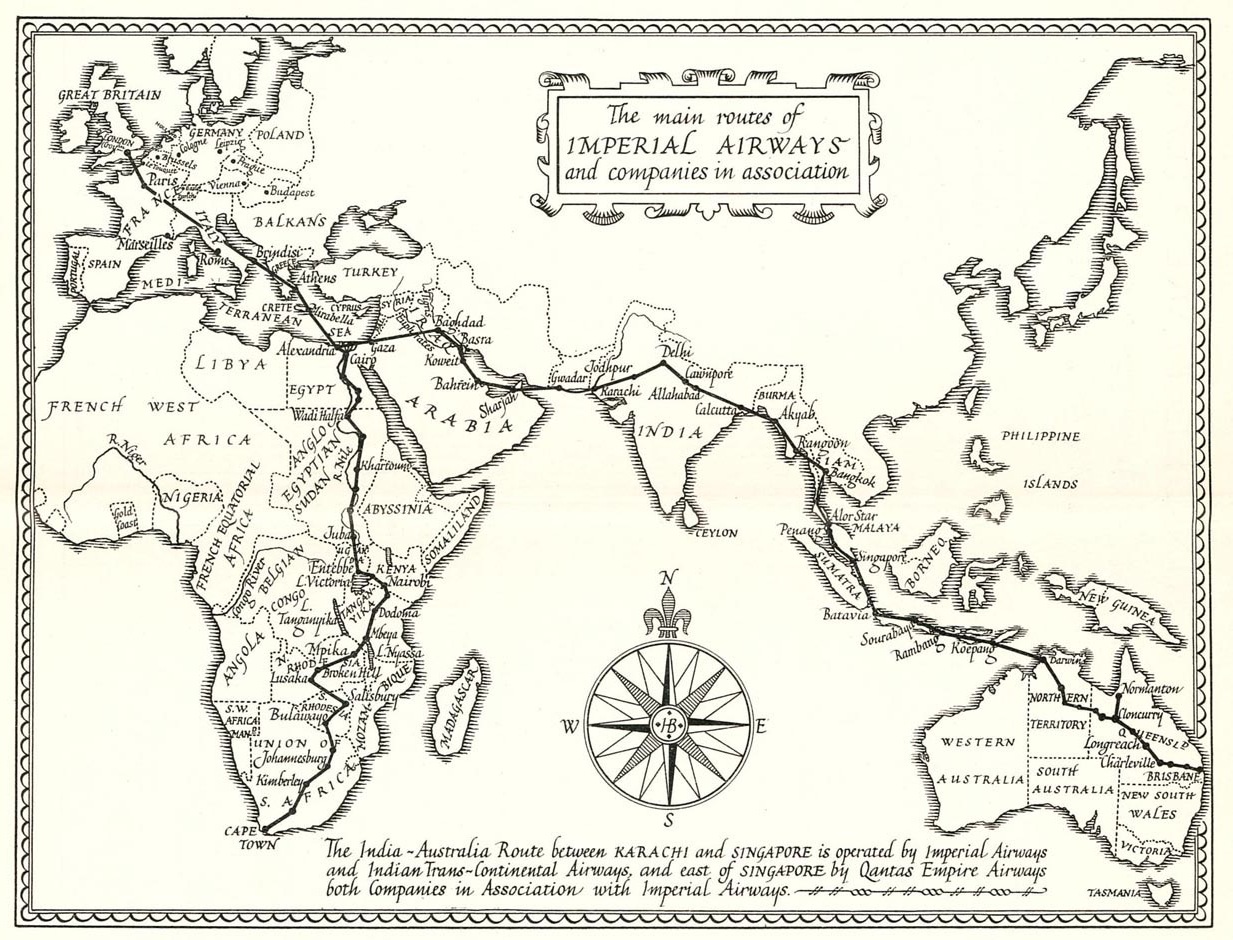
IAL revolutionised global travel by connecting London to the far reaches of the British Empire, transforming weeks-long sea journeys into luxurious multi-day flights using iconic aircraft, setting the operational standard for long-haul intercontinental flying.
It was in April 1931 that IAL’s ill-fated experimental London-Australia air mail flight took place; the DH66 City of Cairo crashed landed in Timor on the 19th April having run out of fuel. The mail had to be transferred to an ANA plane with Smithy and Wyn successfully completing delivery.
About 50,000 passengers used IAL in the 1930s. Most passengers were men in colonial administration, business or research on intercontinental routes or on services within and between British colonies. To begin with only the wealthy could afford to fly, but passenger lists gradually diversified. Travel experiences and opportunities for sightseeing from the air and at glamorous stops were reported enthusiastically in newspapers, magazines and books.
IAL stationed its all-male flight deck crew, cabin crew and ground crew along the length of its routes which is why Wyn lived in Cairo for a few years. Inspectors and specialist engineers like Wyn, and ground crew on rotation or leave, travelled on the airline without generating any seat revenue. At the end of the 1930s IAL had approximately 3,000 crew (several lost their lives in accidents) and all were expected to be ambassadors for Britain and the British Empire.
Wyn's memories
"My life then started with IAL. In all I spent five years with them and really enjoyed the job. Eileen and I lived in the Airport Hotel at Croydon for a while and then rented a freezing flat in Thornton Heath, which was full of indestructible bed bugs and smelled of boiled cabbage. This was not what my fancy-footed bride was expecting as I was told repeatedly.
The first job I had was recuperating an IAL aircraft which had crashed at Orpington in Kent. I was totally shocked by the difference between the English and Australian air mechanics. I reckon that a good Australian mechanic did about three times the work of a good British ex-RAF type, and I said so which did not make me popular.
I was responsible for the operations which in those days went as far as Johannesburg to the south and Calcutta in the east. I had the opportunity of travelling to inspect our planes from time to time and air travel in those days was pure luxury. The itinerary was always arranged to a tried and tested formula of four hours flying in the morning, lunch in comfort on the ground, four hours flying in the afternoon and then a night in a civilised hotel. The food was always good and the transport always comfortable.
Passengers checked in at Victoria Station where they were meticulously weighed together with their baggage. Female travellers and their towers of valises frequently caused difficulties at this point. They were then taken in a luxury coach to Croydon. It was sometimes necessary to off-load fuel before taking off once the all-up weight of the passengers had been established. Late departures due to engine starting problems were too frequent for my liking and the problem became one of my ambitions to remedy. We then departed around 11am on a leisurely 2 ½ -3 ½ hour flight to Paris. As the normal cruising speed was about 100mph, any head or tail wind could make a noted difference on timings. The seating arrangements were very comfortable; deeply cushioned banquettes as found in a good restaurant faced one another across a decent sized table. Lunch was served very leisurely en route by immaculately turned out stewards, and very good four or five course lunches they were too with plenty of Champagne etc. Having arrived at Le Bourget airport, a bus transferred everyone to Paris, leaving those staying in the city at the IAL office in Place de l’Opera. Onward passengers were taken to the Hotel Chatham where they could pass the afternoon until it was time to take the train in the evening.
Mussolini would not allow aircraft to fly over Italy, so it was necessary to take the train right down to Brindisi in the south. In 1931 the wagons-lits on the train were wondrous works of art: single berth wood panelled cabins with comfortable beds, adequate space and restaurant cars with excellent food and service. This night train passed through Switzerland, arriving in Milan the next day just in time for lunch at the Hotel Continental. The next train left in the afternoon with passengers sleeping another night on board and they woke up to Brindisi in the morning. Lunch was served at a hotel followed by a Calcutta flying boat trip of about 2-3 hours to Athens. Another night in a smart hotel then another flying boat trip to Alexandria stopping at Crete en route where IAL kept a yacht for lunch and a rest before taking off for Alexandria in the afternoon, arriving that evening. Then it was a train to Cairo and a night at the magnificent Heliopolis Hotel. Its domed hall is etched in brain as it must have been 80ft high! At Cairo one either took the route south to Johannesburg or east to Calcutta.
On the way south the stops were at Luxor, Khartoum, Malakal, Juba, Kisumu and Nairobi. The trip took four or five days, and it was pleasant going without strain. I did once go blind for three days at Kisumu due to too much sun without sunglasses which greatly alarmed me, but my recovery was swift, and I never repeated that mistake again. The great advantage of flying at about 4-5,000ft was that one could really see the country over which one flew. On the flight to Kisumu on Lake Victoria one could see immense herds of elephants near Malakal or Juba and the pilot would fly lower over them for the pleasure of the passengers. At Malakal, the passengers had to disembark the flying boat where one of my problems was getting them ashore safely. The constant damage done to the plane by the hundreds of hippopotami in the river made my head ache.
Going east it was less interesting. One departed Cairo for Gaza for a night stop, Rutbah Wells (Ar-Rutbar in Iraqi) for a pleasant lunch in the heat then a night stop in Baghdad. The town stank of oil and was incredibly dirty, but the hotel was good. They served a table d’hote which always included a good-sized basin of caviar. I completely lost my taste for it from eating so much.
Then Baghdad to Basra to Kuwait which was nothing more than a large fishing village - the fishing being for pearls. For two or three pounds one could buy a decent sized good quality bauble. The Arab trader poured a sack of them on the table, one examined whatever one liked and he knew exactly the one chosen without appearing to look. Then some amusing bargaining began, and I for one was never sure if I had secured a good deal or not. From Kuwait it was on to our newly agreed stopover depot Sharjah, which at this time was a small fort measuring perhaps 50yds x 50yds. The night was spent outside the fort which was guarded by armed Bedouin who also guarded the aircraft for us. The next day it was a long flight to Karachi, mostly over ocean. We passed over serene giant rays, some of them measuring 30-40ft wing tip to wing tip; they looked like lazy floating islands. The pilot always flew low to give the passengers a good look.
Karachi was one of our engine repair depots, so I usually stayed over for a week or more. I was housed in the local Gymkhana Club which was wonderfully luxurious as it was set out by the British Raj. Golf was played on earthen fairways, there being little water and therefore no grass. The greens were beautifully kept oiled sand and as soon as one left a green it was resurfaced by a native.
The engineering personnel were mostly Sikhs and as workmen they were exceptionally good, far better than the Egyptians and the British. They have always been known for their ability to make rudimentary rifles or repair any kind of broken-down car or lorry, and when given the right equipment they were first class. The only impediment was the strict caste system which stalled a good work flow on occasion. Like Karachi, Cairo was another engine repair depot and was the largest we had, probably as big as Croydon. We were always short of planes and engines and when I first joined we could only fly 50 hours on an engine before it needed a complete overhaul. Unfortunately, we sometimes had to keep the passengers waiting whilst an engine was changed. Bit by bit I got the achievable flying time increased to 500 hours, but we always had a shortfall in equipment.
Generally speaking, my life at IAL was pretty routine and uninteresting. I did have one tricky job of getting an aircraft which had come down in the bush somewhere near Nairobi, back and repaired. This was a big challenge and entailed stopping and holding a freighter at Mombasa, bringing the plane overland in a dismantled state, getting all the special sections of aluminium rolled, and engaging supplementary staff to do the repairs etc. I was given carte blanche as far as costs were concerned and I did get it done in record time, but this small triumph was soon forgotten once the final bill was presented to head office.
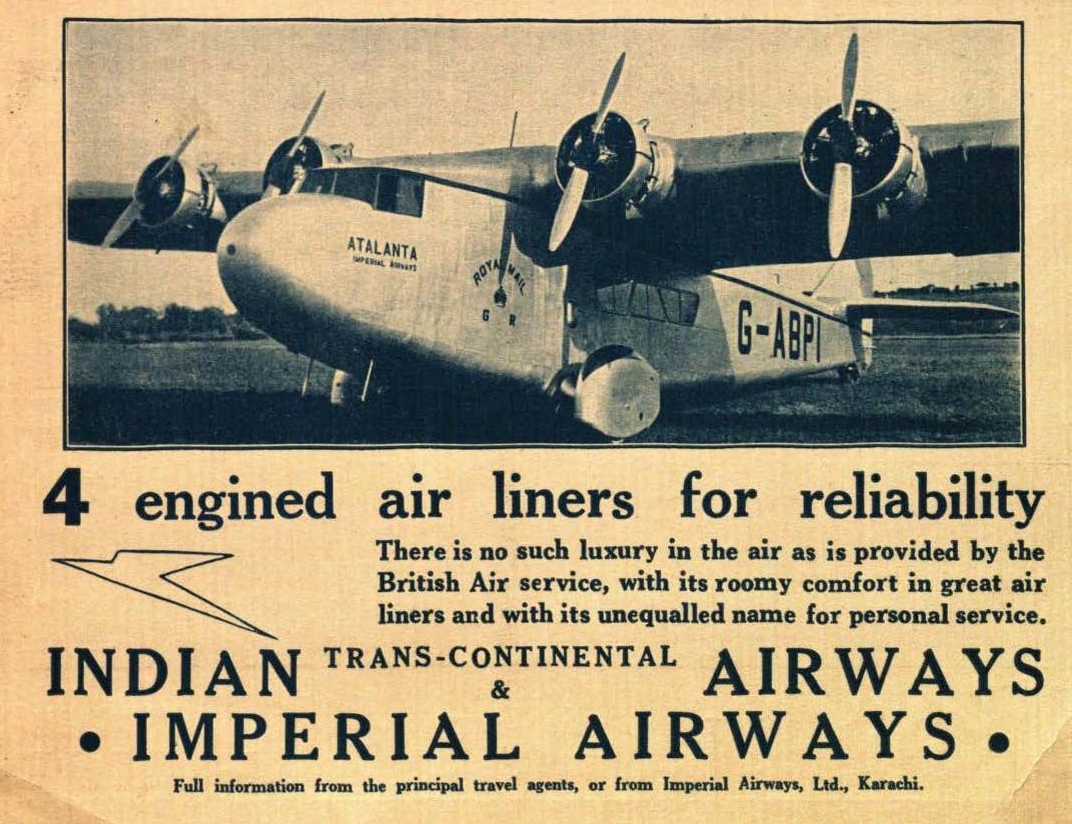
One day, Geoff Wikner (from my Australian garage venture days) turned up asking for a job. Despite some considerable aviation engineering design success in Australia, he arrived in England mid-1934 accompanied by his mother and with just £30 in his pocket. I proposed a position for him, and he started working with me. His first job was to design a passenger seat which could be made to recline as those of today do. He made a very good job of it, and I think they were the first reclinable seats fitted to an aircraft. They were installed in our own Atlantas which were as far as I
remember a four-engine job with wooden wings like the old Fokkers. He had an extraordinary career in the end, forming a company called Foster Wikner, later changed to Foster Wikner Aircraft. I shall never forget his iron grip handshake!